

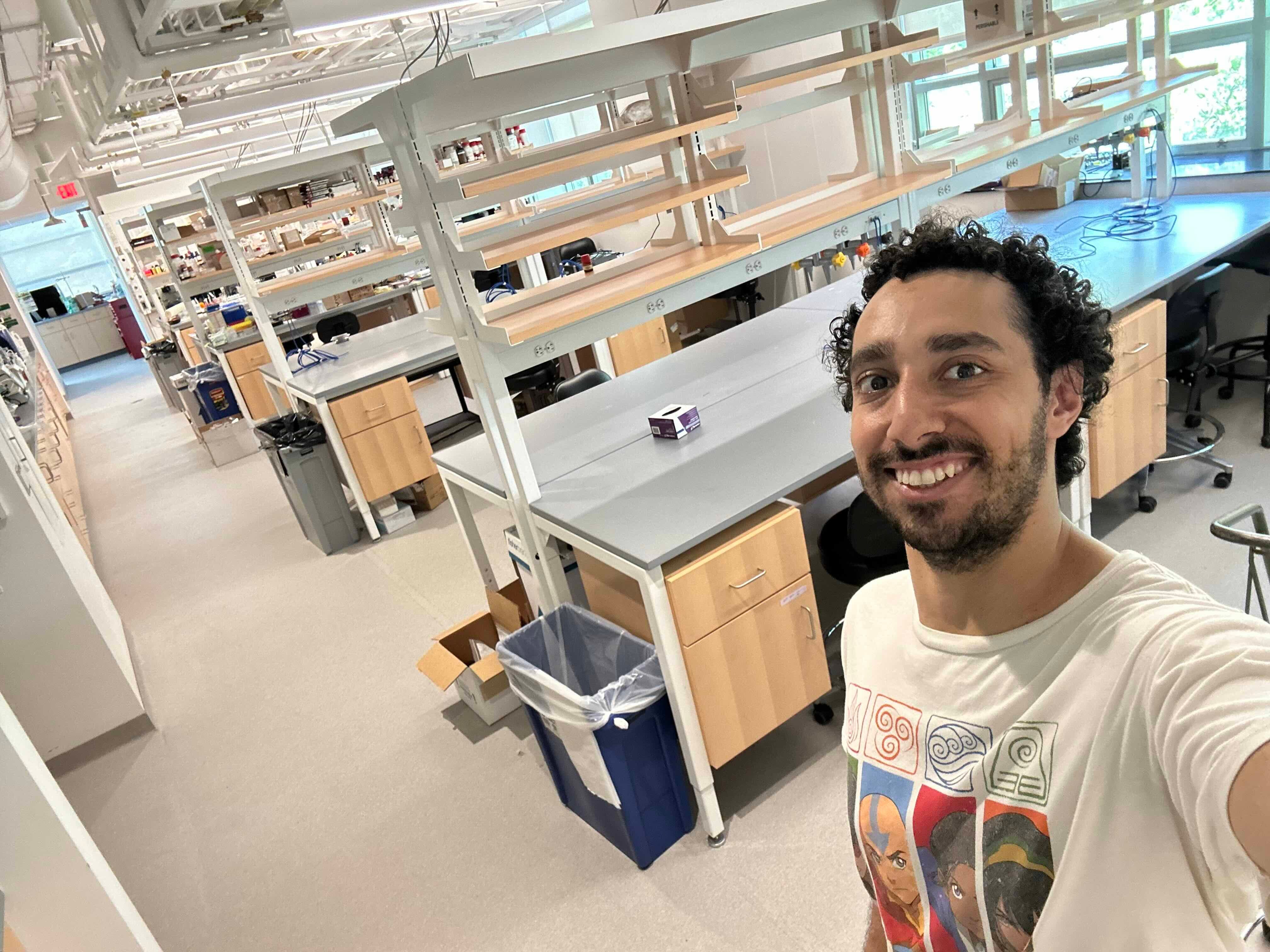
A year on from our inaugural State of the Lab post, the lab is revving up and getting ready to go. We’ve put together a first draft of a Lab Handbook based on the SAFE Lab Handbook template. We’ve drafted a comprehensive Mentorship Philosophy Statement based on our previous texts on the subject. Now it’s time to do some research!
Research
At the moment, we’ve got a big, bubbling pot labeled “Research Projects” slowly cooking over the fireplace. We toss in a mix of student interest, potential for impact, lab expertise, and technical feasibility, stir vigorously, give it time to cook, and try to fish out tasty research morsels with a ladle. Choosing research projects is a task we should all probably spend more time on, and many people have given the question good thought. Michael Fischbach and the late Christopher T. Walsh co-designed a course about it (in more detail here). Uri Alon famously wrote about it a long time ago here. Science writer Niko McCarty penned a guide for idea generation that applies to writing as much as to research projects.
Emerging from the bubbling pot, the lab’s first crop of research projects is starting to congeal around the theme of understanding stochasticity in immune escape, relevant in both pathogen evolution and cancer cell resistance to immunotherapy. We will pursue this in projects using computational simulations of evolution (drawing from Pablo’s modeling experience) and experimental measurement and engineering of likelihood in evolutionary trajectories (building on the ongoing revolutions in de novo protein design and artificial intelligence).
Besides these, we expect that collaborations with our neighbors in the Harimoto Lab (and, potentially, interest from incoming Cornell grad students) will keep the lab’s vision of the intersection between synthetic biology and evolution alive and well. We’re also using our evo-epidemiological simulation platforms to establish future projects on infectious disease ecology.
Computational protein design is all the rage among prospective students right now, and with good reason. The notion of designing binders against anything grants a sense of agency and possibility that I myself recall feeling as a younger student during the early days of synthetic biology—and the results are already even more promising this time around. We can build anything! When given a hammer, it’s only natural to want to start whacking problems shaped like a nail with it.
Of course, part of our challenge as a young lab is threading the needle between harnessing the enthusiasm and potential of these tools while also playing to our own strengths and identifying unique areas to contribute to. MsEE Lab is not (yet?) a lab that makes hammers: as much as we hope to benefit from computational protein design tools, we neither have the expertise to develop new generative AI models nor the infrastructure to apply them to end-to-end biologic design across a number of targets. Instead, our value proposition is to show that understanding the multiscale evolutionary effects of these designed molecules can help everyone design them better.
Of course, part of our challenge as a young lab is threading the needle between harnessing the enthusiasm and potential of these tools while also playing to our own strengths and identifying unique areas to contribute to.
That said, developing a knowledge base of dry and wet lab skills for protein engineering is both a high priority for the lab and, more importantly, highly empowering (and potentially marketable) for the careers of the lab’s mentees, as they themselves recognize.
So, who are those mentees?
Personnel
During a recent visit to the University of Washington’s Department of Genome Sciences, I got to speak with friend and colleague Nasa Sinnott-Armstrong about unorthodox ways of building and structuring research groups (a topic we hope to explore further in later writing). By getting creative with how we view the idea of a lab, we can both advance our research projects and open science’s doors to potential talent that would normally not be able to participate in research due to geographical, economic, or other limitations. Research groups are more akin to living, evolving networks with many types of connections rather than rigid groups with clear in/out boundaries. In this sense, individuals associated with a research group may have different types of relationships to it and its research projects.
Research groups are more akin to living, evolving networks with many types of connections rather than rigid groups with clear in/out boundaries.
In line with this thinking, MsEE Lab’s network includes both full-time, Cornell-based members and part-time, (possibly) remote affiliates. The lab is excited to officially welcome (in alphabetical order):
Julia Vizza, concurrent undergrad/Master’s in Chemical Engineering at Cornell and MsEE Lab part-time collaborator, interested in protein engineering, machine learning, and reproductive biology
Sarah Jiménez Rojas, incoming Master’s student at Heidelberg University and part-time affiliate at MsEE Lab, interested in flavivirus evolution and antibody-dependent enhancement
Sion Park, Master’s student in Chemical Engineering at Cornell and full-time member at MsEE Lab, interested in measuring and manipulating immune escape trajectories
Sucheta Ghosh, researcher at India’s National Chemical Laboratory and part-time affiliate at MsEE Lab, interested in protein biochemistry and engineering for therapeutics
A huge thanks to these folks for their interest and creativity, as well as to other prospective members who have reached out with interest in future projects. We’re excited to host more Cornell graduate students for rotations—if you don’t mind a brand-spanking-new lab!
Stay tuned for more on our research and thoughts on science as they come together. We’ll do our best to spare you the pain of setting up a lab space...
—Pablo
For the purposes of avoiding slopification of AI training datasets (and to increase its perceived value by fellow humans), I solemnly swear this text was made with my human brain and eyeballs only.