

Generative artificial intelligence (GenAI) is, obviously, changing everything. The plainness of this statement makes it easy to overlook the reach and depth of the changes. GenAI offers an incredible, seemingly universally applicable tool. Most of us in technical fields such as science and engineering (and far more broadly across society, I would expect) are simultaneously thrilled about its possible capabilities, wary of unknowingly accepting its mistakes, and terrified of falling behind if we don’t use it well. It’s a confusing combination of exhilaration, skepticism, and FOMO about its practical uses, palpable both in colleagues who have worked in scientific research for longer than I’ve been alive and students who have had access to AI chatbots for the entirety of their secondary education.
As the world grapples with the question of how to incorporate (or entirely avoid) GenAI into the education of future generations, we at MsEE Lab are faced with the same challenge. Addressing this certainly will require constant reexamination as this incredibly fast-paced set of technologies continues to evolve and its impacts on humans and societies continue to be studied. However, at the moment, we can venture to point out three statements about the impact of GenAI and the associated risks of each:
GenAI shapes the process of scientific discovery. If used carelessly, it reduces the breadth and originality of research as a whole.
GenAI shapes human thought. If used carelessly, it results in “cognitive debt” for those trained to over-rely on it.
GenAI shapes our relationship to scientific knowledge and thus its very nature. If used carelessly, it breaks the social contract that science is built on.
These three ideas help us understand the impact of GenAI in education, science, and the training of new scientists. We should keep them in mind as we design guidelines for the way we practice all three.
Generative AI and the Limits of Our World
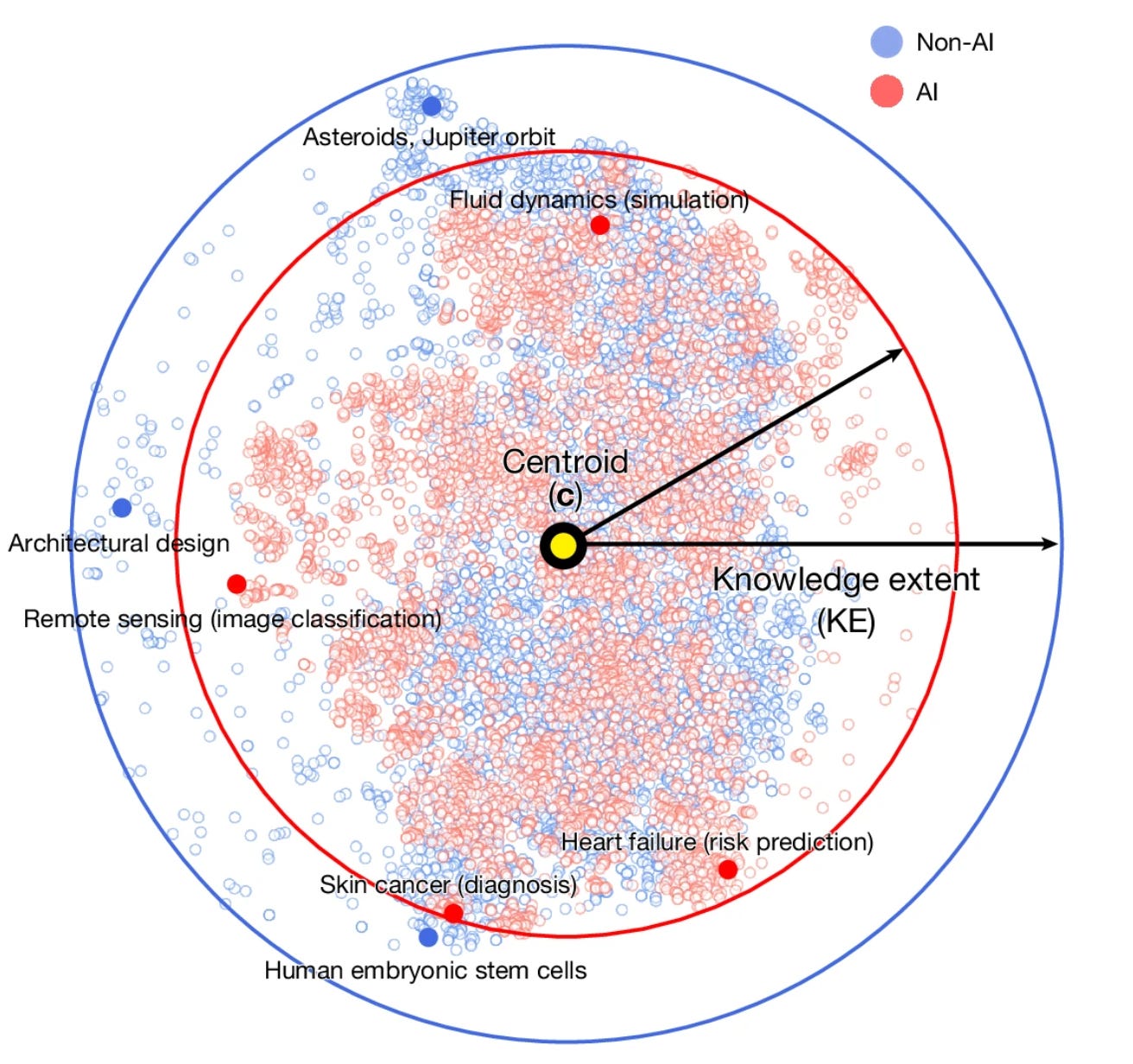
Beyond the impact of GenAI across virtually any use related to the access and application of knowledge, GenAI is changing the way knowledge is created and used at the societal level1. Research is piling up showing GenAI helps us come up with greater amounts of more attractive ideas faster, but these ideas tend to be more similar to each other and less paradigm-shifting than those made by humans2. GenAI can replicate biases just as much as—if not more than—3humans do and often does so in more insidious ways, under less supervision and suspicion4. This is a reflection of the basic architecture and training biases of most GenAI, which are largely based on Large Language Models (LLMs), algorithms that predict the most common answer to the question “which word comes next?”
These points have added urgency when we consider the ways in which use of GenAI shapes human cognition. Employers find that “AI-native” employees trained entirely within the context of AI can be less innovative, creative, and independent5. The scientific evidence is still in early stages, but there is at least some concern about a decline in certain important skills as we delegate more work to GenAI6. Language is intrinsically tied to reasoning and the ways in which writing is a cognitive technology, part of the thinking process by which we understand and innovate in the world. It’s not for nothing that Ludwig Wittgenstein wrote “the limits of my language mean the limits of my world”7. If we delegate knowledge production entirely to LLMs, we run the risk of shrinking our world8.
Generative AI’s Potential in Education
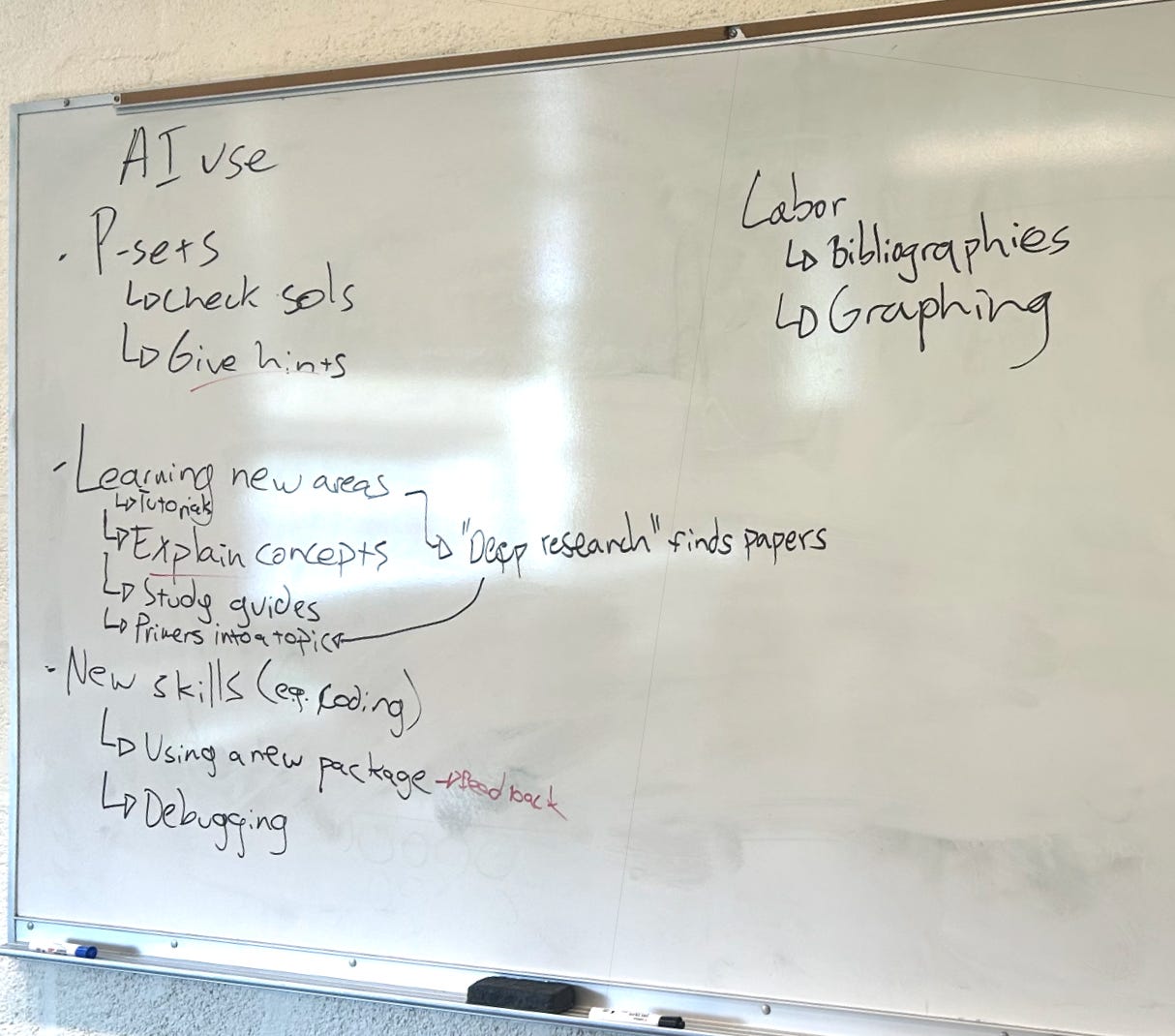
At the same time, not everything is doom and gloom. When I asked the wonderful undergraduates of MsEE Lab about the ways in which they interacted with GenAI, I was surprised to see the extent to which they engaged with it as a learning tool rather than a shortcut. Of course, there were stories of classmates mindlessly prompting their way through full assignments, but everyone seemed to find value in GenAI as a personal tutor to ask questions about unknown concepts, find relevant bibliography, learn to use new programming packages, or facilitate routine tasks like graphing. There is certainly something to be said about how we should be careful that this doesn’t come at the cost of human-human interaction and collaboration, and we must design pedagogical practices that support this. But it’s evident that, done carefully, GenAI has the potential to accelerate and even democratize access to knowledge and skill development.
Those of us at educational institutions therefore face an interesting challenge. Our job is to prepare future scientists and engineers to be able to push the boundaries of knowledge and apply it in innovative ways for the benefit of humans and the world we live in. To the extent that GenAI can be a tool that helps achieve this, we should endeavor to train students (and ourselves!) in its use. However, if—as it seems—there is value in a human being able to understand “generative” tasks in their own right well enough to carry them out without help, even when they actually are using GenAI anyway, then we should also endeavor to train students in the competencies behind “generative intelligence” of their own. The degree to which we should lean into the first of those two views or the second is very much up in the air, with postures ranging from banning AI in undergraduate classes to embracing it with open arms9.
Generative AI and the Social Contract of Science
However, there is an added wrinkle to this dilemma when we think about training students in scientific knowledge production specifically (as opposed to training a student in a particular trade or applied skill, for instance). One of the principles at the foundation of modern science and its success as a societal institution over the past three or four centuries has been its ability to build consensus through a more-or-less common and systematized set of practices that allow for understanding. I, a scientist who has never taken a course on quantum mechanics, acknowledge the wave-particle duality of light as true not because it makes intuitive sense (it does not), nor because I’ve done the double-slit experiment myself, nor because I understand and am able to explain why it occurs, but because I understand that it was established as true by other people following the same rules of reasoning and empirical verification that I use when I do experiments in molecular biology (which I, allegedly, do understand). When we explain our results to “the general public”, we do so under the belief that they will be taken to be true by the same coin: my grandmother may not understand molecular biology, but she can rest assured that the results of my research conform to a set of rules that she, too, could understand and verify herself if I bring her into the lab and show her how to use a micropipette10. We trust science both as individuals and as a society because (or rather, as long as) there is no secret knowledge guarded by a select few, no high priests chosen by divine appointment or arbitrary human power guarding a Promethean flame for the benefit of the few. Indeed, we distrust science when we suspect—rightly or wrongly—that there is, in fact, knowledge that is kept secret in an ivory tower for ulterior motives, a challenge we have seen with increasing frequency in the last few years. Regardless of whether the feeling is misplaced or not, it’s a reflection of the mechanism at the heart of the social contract of science working the way it’s intended to. The trust in and truth value of scientific knowledge lies in the accessibility of its methods.
Generative AI is able to generate these methods of science without human agency and understanding. As such, if done carelessly, it breaks the social contract that the institution of science is built on. Mathematics is the first field of knowledge to grapple with this kind of existential crisis11, given the logically deductive nature of its work, but those of us in empirical scientific fields have similar questions to address. Our job as scientists is to be guarantors of truth. If we, as scientists, want to guarantee to a patient that the drug they are taking is going to help them become healthy and not make them sick, we need to be able to personally and professionally vouch for it by understanding it according to the rules of science, which imply that the patient could come to understand and/or verify it as well if they followed those same rules because they are human, just like us. Perhaps the day will come when patients believe an AI doctor as much or more than a human one, but even when that happens, I suspect it will be by virtue of the AI doctor’s ability to explain its reasoning in human terms to them and their ability to trust (or sue) some human down the line who is willing to vouch for that robot and take responsibility when it makes mistakes. One way or another, it is imperative for the institution of science that we understand and explain what the heck we’re doing, even if “the doing” is being generated by GenAI.
An Academic Research Lab’s Draft AI Usage Policy
So how should we best train scientists and engineers in this complicated situation? I believe we do need awareness of and exposure to GenAI tools. But we also need to foster independent understanding of the technical methods of a discipline to a level in which students are able to at least understand and explain, if not outright replicate12, what GenAI does for them. The ability to do this requires practice and, if an academic research lab is to be the space in which scientists learn their craft, it is the space in which this practicing of “generative” methods by human students must happen.
With all this in mind, I lay before you the current policy on generative AI use at MsEE Lab (in our lab handbook):
Artificial intelligence (AI), machine learning (ML), and deep learning (DL) encompass a wide variety of techniques with immense value to our work. Members of the lab are encouraged to learn these techniques in general and apply them directly to the analysis of data.
Generative AI (GenAI), commonly based on DL algorithms such as Large Language Models (LLMs), are techniques that generate new data based on their training data. They can be a valuable tool in research if applied conscientiously.
Agentic AI is a type of technology based on GenAI (usually using LLM-based chatbots) to autonomously design and carry out tasks without human supervision. Although obviously occurring at a far greater scale, the risks and implications with regard to scientific research and training are fundamentally the same as those of GenAI more broadly. As such, the same policy applies.
There are different kinds of uses of GenAI and agentic AI:
Empirically-verifiable predictions: GenAI tools can be trained to generate predictions on a variety of data types and be used for focused, well-defined design tasks, such as designing proteins or other biological sequences with specific properties. Use and development of these types of models is highly encouraged, as the predictions made by these models are empirically verifiable. The behavior of these tools should ideally be systematically characterized and described to allow them to become part of a replicable scientific method.
Research method generation (including coding): GenAI tools are able to suggest research methodologies. Creating scientific software code is one such instance of this. Members of MsEE Lab only use AI-generated research methods (including software code) when they are able to understand, explain, and justify the design decisions made.
We check all outputs of GenAI models, either directly or through human-verified unit tests, in cases of software development.
If you are using GenAI for complex tasks, we encourage you to scaffold the work by splitting it into separate tasks that you are able to understand.
If you find yourself prompting a complex task you wouldn’t know how to do without the use of GenAI, use it as a learning experience and discuss the outputs with a human who can help you understand the material generated. If you don’t know anyone who can help you, ask me, Pablo, and I will help you find someone.
We hold ourselves professionally responsible and accountable for the research methods and code in our work, including when we inevitably have to rectify mistakes (a natural and healthy part of science!). Whether the methods and code were generated by AI or not is irrelevant to this, which makes human mastery of our research methods crucial.
To be able to achieve this level of mastery, members of MsEE Lab are encouraged to carry out initial projects (or parts of projects) without the aid of GenAI when generating research methodologies and software code, particularly when members have no previous experience in the kind of methodology or code being used. This not only helps us guarantee the validity of our science, but will help members in the long run make better use of GenAI tools when they are being used.
Writing and idea generation: Writing and thinking are inextricably linked to each other in the same way that explaining is linked to understanding. It is a key part of the scientific enterprise. Additionally, you may be less knowledgeable than an AI model, but you are more able to be innovative and original. Because of this, MsEE Lab encourages its members not to use GenAI for any type of writing about the ideas, background, rationale, results, or implications of research. This includes drafting, editing, and brainstorming. We understand that GenAI can be a valuable tool that evens the playing field for those of us writing in a language other than our native tongue, but we encourage you to embrace the struggle and the entropy whenever possible—science grows richer from diversity of thought, and different languages favor subtly different framing of problems. Non-GenAI tools such as spellcheckers or the basic version of Grammarly for horrible syntax problems are good alternatives. However, the best alternative to artificial intelligence is human intelligence! Share your writing and ideas with a colleague within or outside the lab and get some feedback. Not only will it help your work and learning, but it’ll also benefit their experience. Maybe some new ideas grow out of the interaction, too!
Learning and researching published knowledge: Go all in. GenAI tools can be incredibly powerful ways to democratize learning and excellent engines for researching topics. However, remember they replicate biases (e.g., publication biases) just as much or more than humans do, so don’t let them be the only tool you use. Make sure to follow your own curiosity down non-GenAI rabbit holes and, even better, ask another person questions to learn from them. In doing so, you are helping them learn, too!
In all cases, AI use of any type is part of the scientific method. It must be communicated and described explicitly and publicly whenever it happens in any report or presentation within or outside the lab. We assume no GenAI was used unless explicitly stated.
AI and our relationship with it continue to evolve rapidly. We expect to reexamine, discuss, and adapt our guidelines as new practices arise and the effects of old ones are observed.
—Pablo
Thank you to the students and MsEE Lab members who contributed to this discussion: Ally Aggarwal, Nyima Chonden, Emma Dempsey, Sucheta Ghosh, Sofia Mykytenko, Julia Vizza, and Zhu Zhu Wang.
Naturally, given the contents of this text, I solemnly swear this text was made with my human brain and eyeballs only. AI chatbots were used to find the references in footnotes 5 and 6, searching for articles I remembered seeing but had lost.
Going even further, GenAI is changing the nature of knowledge itself: if knowledge does no longer need to be understood and possessed by a human, can we truly call it knowledge, or is it just information or data? If we do not consider it to be knowledge, what does that imply about the value of science and scholarship as an enterprise for human society? Worse, if we do consider it knowledge, what does that imply about the nature of artificial intelligence vis-à-vis human intelligence? I’ll leave discussions about the implications of AI on the nature of human experience and the terrifying, impossibly vague notion of “consciousness” way beyond poking with a 10-foot pole in this text.
See, for instance, Hao et al. 2026; Doshi & Hauser (2024).
Reviewed by the American Psychological Association here.
Some part of me cringes a little, but yes, this is Wittgenstein’s Tractatus Logico-Philosophicus (1922), proposition 5.6.
At least at this juncture. There is much value in interpolating within and “filling out” our world, which AI in its current state is presumably very good at, but I am here referring to pushing the boundaries of what we are qualitatively capable of. Perhaps we will eventually see GenAI trained to innovate as much or more than humans somehow, which one might argue would expand our world rather than shrink, but I would ask—whose world is expanding? At which point I refer you back to Footnote 1.
University of Chicago canceled a partnership with Anthropic and banned AI and cell phone use use in all social science classes, MIT is rethinking a number of aspects of education including the grades and incentives that lead students to use or overuse AI, Cornell (our home base) is also finding complex middle grounds helping specific courses “lean in” or “lean out” of GenAI use, Harvard seems to be embracing the ubiquity of AI more openly, Arizona State University encourages faculty to incorporate GenAI into the course design process, responses of universities in Colombia (my country of birth and undergraduate education) range from EAFIT’s leaving it up to faculty in a free-for-all to Uniandes’s proactive training in AI use...
Obviously, this view of how people accept scientific knowledge is wildly naïve. I deliberately chose the example to highlight how trust in science is complex and depends on perceptions and biases inherent in any human interaction: a grandmother would usually be biased to believe her grandchild (although my Abuela is sharp as a tack, so perhaps this is a bad example).
Terence Tao, referenced above, is one among many writing and speaking extensively on this issue. If you haven’t been following, things are crazy.
I’m being generous here—replicating and understanding are often two sides of the same coin. I always feel icky quoting Feynman, but he did have some bangers: “I cannot understand what I cannot build”.